
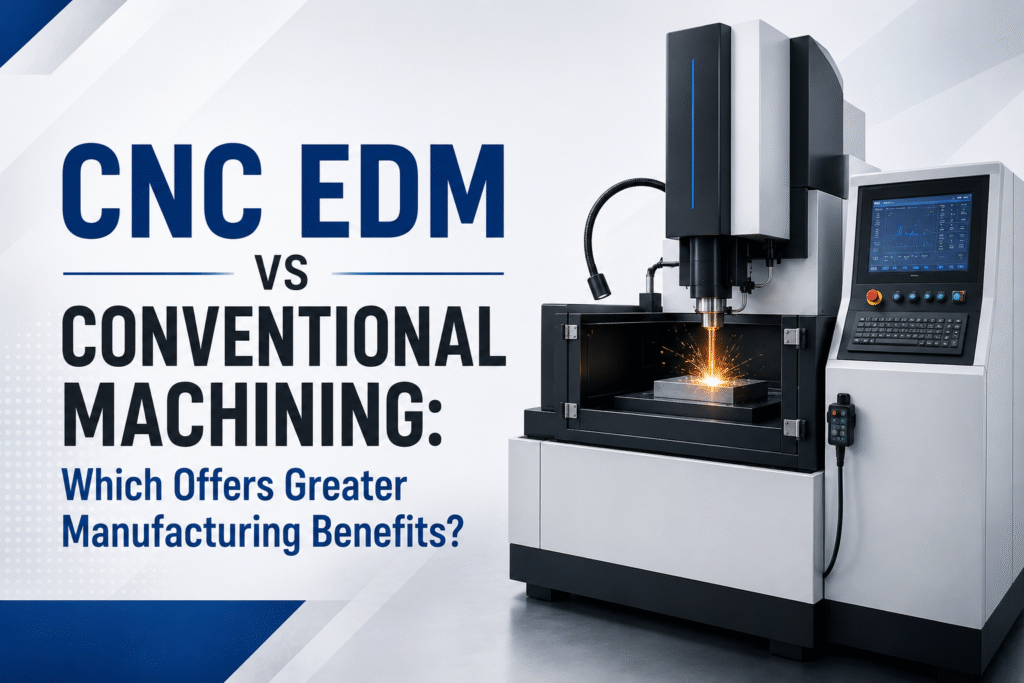
In the world of precision manufacturing, the debate often boils down to a choice between speed and capability. While traditional CNC milling and turning are the workhorses of the modern shop, there comes a point where “cutting” simply isn’t the most efficient way to remove material.
If you are evaluating whether to stick with traditional methods or upgrade your facility, understanding the tipping point of CNC EDM machine vs conventional machining is critical for your ROI.
Understanding the Fundamental Difference
Before diving into the “when,” it’s important to understand the “how.”
- Conventional Machining: Uses physical cutting tools (end mills, drills, lathes) to mechanically remove chips from a workpiece.
- CNC EDM (Electrical Discharge Machining): Uses thermal energy created by electrical sparks to vaporize material. There is no physical contact between the tool and the workpiece.
1. When Material Hardness Exceeds Tooling Limits
Conventional machining relies on the cutting tool being harder than the workpiece. When dealing with hardened steel, titanium, or nickel-based superalloys (Inconel), traditional tools wear out rapidly, leading to frequent downtime and high tooling costs.
The EDM Advantage: Because EDM uses electricity rather than force, the hardness of the metal is irrelevant. If the material is conductive, EDM can machine it with high precision, regardless of how “tough” it is.
2. When Dealing with Complex Geometries and Sharp Internal Corners
Standard CNC mills use rotating round tools. This makes it physically impossible to create perfectly sharp internal 90-degree corners or deep, narrow slots without leaving a radius.
The EDM Advantage: CNC Sinker EDMs can use an electrode machined to the exact shape of the desired cavity. This allows for:
- Square internal corners.
- Deep, thin ribs that would cause a traditional drill bit to deflect or break.
- Intricate patterns required in injection molding dies.
3. When the Workpiece is Fragile or Thin-Walled
Mechanical machining exerts significant “cutting forces” on a part. For thin-walled components or delicate aerospace parts, these forces can cause bending, warping, or total part failure.
The EDM Advantage: EDM is a non-contact process. Since there is no mechanical pressure, you can machine incredibly thin walls and delicate structures that would otherwise collapse under the pressure of a milling cutter.
4. When a Mirror-Like Surface Finish is Required
Conventional machining often leaves “chatter marks” or visible tool paths that require secondary manual polishing a process that is both slow and prone to human error.
The EDM Advantage: Modern CNC EDM machines can achieve extremely fine, uniform surface finishes (often measured in microns) directly off the machine. This is vital for medical implants and high-end mold making.
Investment Comparison: At a Glance
| Feature | Conventional Machining | CNC EDM |
| Primary Goal | High-volume material removal | Intricate, hard-metal precision |
| Tool Wear | High (physical friction) | Low (no contact) |
| Setup Time | Faster for simple parts | Longer (electrode fabrication) |
| Complexity | Limited by tool shape | Nearly unlimited |
The Verdict: When to Make the Move?
Investing in a CNC EDM machine vs conventional machining isn’t about replacing one with the other; it’s about expanding your shop’s ceiling.
Invest in CNC EDM if:
- Your scrap rates are rising due to tool deflection on deep cavities.
- You are turning away high-margin jobs involving hardened alloys.
- You specialize in mold and die making where sharp internal corners are non-negotiable.
- You want to reduce labor costs associated with manual post-polishing.
While conventional machining will always win on speed for soft metals and simple shapes, CNC EDM is the strategic investment for manufacturers ready to tackle the “impossible” jobs that competitors can’t touch.