
Modern manufacturing demands extreme precision, especially when producing complex components made from hard metals and advanced alloys. One of the most effective technologies used to achieve this level of accuracy is Electrical Discharge Machining (EDM). Unlike traditional machining processes that rely on mechanical cutting tools, EDM uses controlled electrical sparks to remove material from a workpiece.
This advanced machining technique has become essential in industries such as aerospace, automotive, electronics, and medical device manufacturing. With increasing demand for high-precision components, EDM continues to play a critical role in modern manufacturing processes.
What is Electrical Discharge Machining (EDM)?
Electrical Discharge Machining is a non-traditional process that removes material using a series of rapid electrical sparks between two electrodes. The workpiece and the electrode are submerged in a dielectric fluid; when voltage is applied, sparks are generated that create intense heat, melting and vaporizing small portions of the material.
Because EDM involves no direct physical contact between the tool and the workpiece, it is the go-to solution for machining incredibly hard materials like:
- Hardened steel and Tungsten carbide
- Titanium alloys
- Inconel and other aerospace superalloys
How EDM Works
The process operates through a controlled sequence of electrical discharges:
- The conductive workpiece and electrode are positioned with a microscopic gap between them.
- Both are immersed in a dielectric fluid (usually deionized water or oil).
- Voltage triggers thousands of sparks per second.
- The fluid flushes away debris, constantly cooling the surface and preparing it for the next discharge.
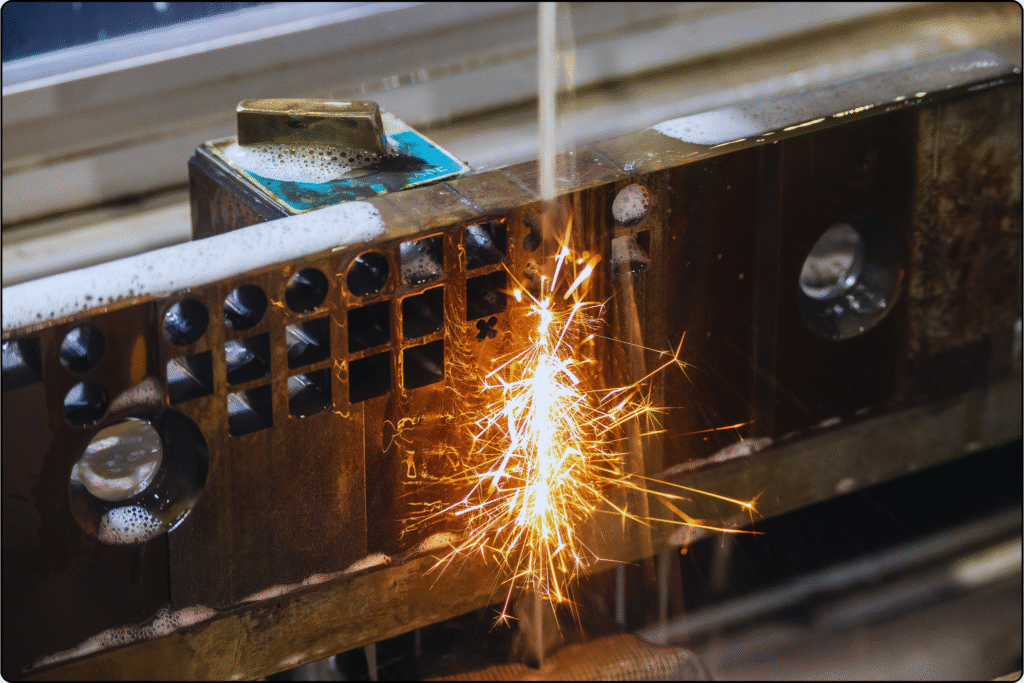
Electrical Discharge Machining (EDM) process removing material using controlled spark erosion for high-precision component shaping.
Types of EDM Machines
While there are several variations, two primary types dominate the modern shop floor:
- Wire EDM: Uses a thin, continuous wire to cut precise shapes through metal, much like a high-tech cheese slicer. It currently holds the largest share of the market (over 50%) due to its essential role in producing medical implants and electronic parts.
- Die-Sinking EDM (Ram EDM): Uses a shaped electrode to “sink” a specific cavity into a workpiece. It is the gold standard for mold and die manufacturing, particularly for the automotive sector.
- Hole Drilling EDM: Specialized for creating microscopic, deep holes—most notably the cooling holes found in high-performance jet engines.
Why Manufacturers Choose EDM
- Zero Mechanical Force: Since the tool never touches the part, there is no risk of bending or breaking fragile components.
- Complex Geometries: EDM can create sharp internal corners and intricate “blind” cavities that are physically impossible for a rotating drill bit to reach.
- Hardness is Irrelevant: Whether the metal is soft copper or ultra-hard carbide, the spark erodes it with the same level of ease.
Market Growth and Future Trends
The EDM market remains on a steady upward trajectory, valued at approximately USD 3.5 billion as we move through 2026. This growth is fueled by a global shift toward Electric Vehicles (EVs) and the miniaturization of consumer electronics.
Key Trends for 2026:
- AI Integration: Modern EDM machines now feature real-time “spark sensing” that uses AI to prevent wire breakage and optimize cutting speed.
- Sustainability: New “Green EDM” initiatives are focusing on biodegradable dielectric fluids and energy-saving power generators to reduce the carbon footprint of the machine shop.
- Automation: The integration of robotic arms for electrode changing is allowing many EDM facilities to run “lights-out” 24/7 operations.
Conclusion
Electrical Discharge Machining has revolutionized the way we handle “unmachinable” materials. By turning electricity into a cutting tool, EDM enables the creation of the complex, high-performance parts that power our world—from the engines in our planes to the implants in our bodies. As industries demand even higher levels of accuracy, EDM technology will continue to evolve as a cornerstone of modern engineering.