
Introduction
Modern manufacturing relies heavily on precision machining processes to produce complex components with high accuracy. Two of the most widely used technologies in this space are Wire Electrical Discharge Machining (Wire EDM) and CNC Machining.
While both methods are capable of producing precise parts, they operate using very different principles and are suited for different types of materials and applications. Understanding the differences between these two machining processes helps manufacturers choose the right method for their production needs.
What is CNC Machining?
CNC (Computer Numerical Control) machining is a subtractive manufacturing process where computer-controlled tools remove material from a workpiece to create the desired shape.
Common CNC machining processes include:
- CNC milling
- CNC turning
- CNC drilling
- CNC grinding
CNC machines use rotating cutting tools to shape metals, plastics, and composites. These machines are widely used in industries such as automotive, aerospace, electronics, and medical manufacturing.
Key Advantages of CNC Machining
- High production speed
- Suitable for a wide variety of materials
- Excellent for 3D shapes and complex parts
- Ideal for mass production
What is Wire EDM?
Wire EDM (Wire Electrical Discharge Machining) is a non-contact machining process that uses a thin electrically charged wire to cut through conductive materials using controlled electrical sparks.
The process works by creating thousands of sparks per second between the wire and the workpiece, gradually eroding the material.
Wire EDM is commonly used for machining:
- Hardened steel
- Titanium alloys
- Carbide
- Aerospace-grade metals
Key Advantages of Wire EDM
- Extremely high precision
- No mechanical cutting force
- Ability to machine very hard materials
- Ideal for intricate and delicate components
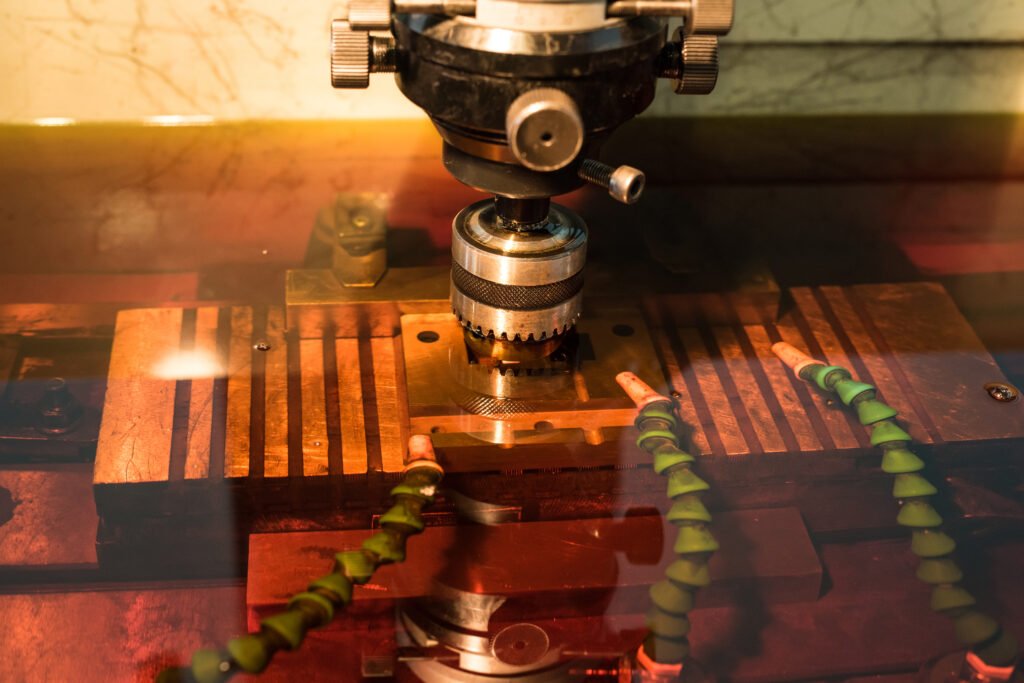
Wire EDM vs CNC Machining: Key Differences
| Feature | Wire EDM | CNC Machining |
| Cutting Method | Electrical sparks | Rotating cutting tools |
| Contact with Workpiece | No physical contact | Direct tool contact |
| Material Type | Conductive metals only | Metals, plastics, composites |
| Precision | Extremely high | High |
| Speed | Slower | Faster for large volumes |
When to Choose Wire EDM
Wire EDM is the preferred choice when:
- Extremely tight tolerances are required
- Materials are very hard or heat-treated
- Intricate shapes or sharp internal corners are needed
- Tool pressure could damage delicate components
Industries such as aerospace, medical devices, and tool manufacturing rely heavily on Wire EDM for precision parts.
When to Choose CNC Machining
CNC machining is the better option when:
- Parts require 3D shapes or complex surfaces
- Production volumes are high
- Materials include plastics or non-conductive materials
- Faster production times are required
This process is widely used in automotive manufacturing, electronics production, and industrial equipment manufacturing.
Future Trends in Precision Machining
Both Wire EDM and CNC machining continue to evolve with advancements in automation, artificial intelligence, and smart manufacturing technologies.
Modern manufacturing facilities increasingly integrate both processes within the same production environment to maximize efficiency and precision.
With the growth of industries such as electric vehicles, aerospace engineering, and advanced electronics, demand for high-precision machining technologies is expected to increase significantly in the coming years.
Conclusion
Wire EDM and CNC machining are both essential technologies in modern manufacturing. While CNC machining is ideal for faster production and versatile materials, Wire EDM excels in delivering extremely precise cuts in hard conductive materials.
By understanding the strengths of each method, manufacturers can select the most effective machining process for their specific production requirements.