
Introduction
In industries where precision is non-negotiable, mold quality directly impacts the performance, consistency, and lifespan of the final product. From automotive components and medical devices to electronics and packaging solutions, manufacturers depend on high-accuracy molds to achieve superior results.
Traditional machining methods can struggle when producing intricate geometries, sharp corners, and tight tolerances. This is where Wire EDM (Electrical Discharge Machining) has transformed mold manufacturing. By using controlled electrical discharges to cut conductive materials, Wire EDM delivers exceptional precision without applying mechanical force to the workpiece.
Let’s explore why Wire EDM has become a preferred solution for flawless mold making.
What is Wire EDM?
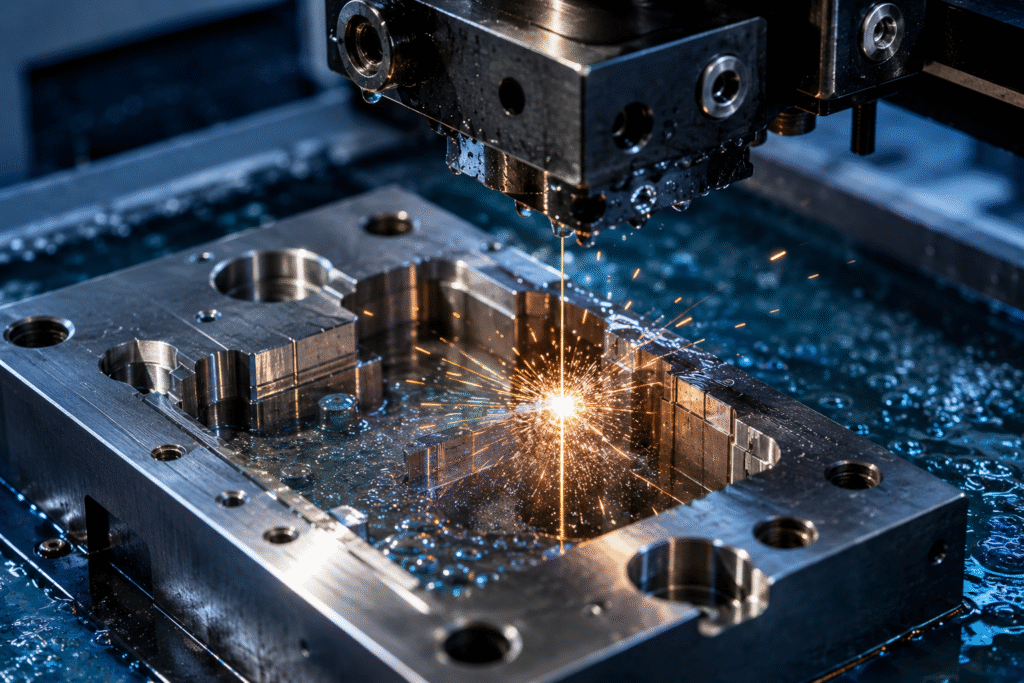
Wire EDM is a non-contact machining process that uses a thin electrically charged wire to cut through conductive materials. Instead of physically removing material with a cutting tool, a series of controlled electrical sparks erodes the material with remarkable accuracy.
The process is ideal for machining hardened tool steels, carbide, titanium, and other difficult-to-machine materials commonly used in mold manufacturing.
Key Advantages of Wire EDM for Mold Making
1. Exceptional Precision and Accuracy
Modern molds often require extremely tight tolerances to ensure consistent part production. Wire EDM can achieve precision levels that are difficult to match with conventional machining methods.
Benefits include:
- Tight dimensional accuracy
- Consistent repeatability
- Superior component fit and alignment
- Reduced need for secondary finishing
This level of accuracy is particularly important for injection molds, die-casting molds, and precision tooling applications.
2. Ability to Create Complex Shapes
Many molds contain intricate cavities, narrow slots, sharp internal corners, and complex contours. Traditional cutting tools may struggle to access these features effectively.
Wire EDM enables manufacturers to produce:
- Detailed profiles
- Intricate cavities
- Fine slots and openings
- Complex punch and die geometries
The process allows designers greater freedom without compromising manufacturability.
3. No Mechanical Cutting Force
Unlike conventional machining processes, Wire EDM does not exert physical cutting pressure on the workpiece.
This provides several advantages:
- No tool-induced distortion
- Reduced risk of cracking
- Improved dimensional stability
- Better accuracy on delicate components
This is particularly beneficial when working with thin sections and intricate mold features.
4. Machining of Hardened Materials
Many mold components are heat-treated to improve wear resistance and durability. Conventional machining after hardening can be difficult, time-consuming, and expensive.
Wire EDM can efficiently machine:
- Hardened tool steel
- Carbide
- Titanium alloys
- High-strength conductive materials
This allows manufacturers to machine parts after heat treatment while maintaining high precision.
5. Excellent Surface Finish
A high-quality surface finish is essential for mold performance and the appearance of molded parts.
Wire EDM helps achieve:
- Smooth surface finishes
- Reduced polishing requirements
- Better mold release characteristics
- Improved product aesthetics
Less manual finishing translates into shorter production cycles and reduced manufacturing costs.
6. Reduced Material Waste
The thin wire used in the EDM process creates a narrow kerf width, minimizing unnecessary material removal.
Advantages include:
- Better material utilization
- Lower raw material costs
- Reduced scrap generation
- Increased efficiency for expensive materials
This becomes especially valuable when machining high-cost tool steels and specialty alloys.
7. Consistent Quality and Repeatability
Modern manufacturing demands repeatable processes that produce identical results over multiple production runs.
Wire EDM offers:
- Reliable dimensional consistency
- Stable machining performance
- Accurate reproduction of complex geometries
- Reduced variation between mold components
This consistency contributes to improved production quality and reduced rejection rates.
Industries Benefiting from Wire EDM Mold Manufacturing
Wire EDM plays a vital role in mold and tooling applications across numerous industries:
- Automotive manufacturing
- Aerospace components
- Medical device production
- Electronics and semiconductor manufacturing
- Consumer goods production
- Packaging industry
- Precision engineering
As products become more complex, the demand for high-precision mold making continues to increase.
Why Wire EDM is Essential for Modern Mold Making
Today’s molds require greater precision, tighter tolerances, and increasingly complex geometries than ever before. Wire EDM provides manufacturers with a reliable method for producing these demanding components while maintaining quality and efficiency.
By enabling precise machining of hardened materials, reducing distortion, and creating intricate designs, Wire EDM helps mold makers achieve superior results while shortening production timelines.
Conclusion
The success of any molded product begins with the quality of the mold itself. Wire EDM has become an indispensable technology for mold manufacturers seeking precision, repeatability, and design flexibility.
Whether producing injection molds, dies, punches, or precision tooling, Wire EDM offers the accuracy and reliability needed to meet modern manufacturing requirements. For companies striving to create flawless molds and high-quality end products, Wire EDM remains one of the most effective machining solutions available.