
In Wire EDM machining, selecting the right wire can significantly impact production costs, machining efficiency, and overall profitability. Among the most commonly used wire materials are molybdenum and brass, each offering distinct advantages depending on the application.
While brass wire is widely used in conventional Wire EDM systems, molybdenum wire has gained popularity due to its reusability and lower consumable costs. But which option delivers better value for your shop?
Let’s compare both wire types to help you make an informed decision.
Understanding Molybdenum Wire EDM
Molybdenum wire is primarily used in reciprocating Wire EDM machines, where the wire continuously moves back and forth during the cutting process. Unlike disposable wire systems, molybdenum wire can be reused multiple times before replacement.
Key Benefits of Molybdenum Wire
- Reusable wire reduces consumable expenses.
- High tensile strength allows stable cutting performance.
- Suitable for extended machining operations.
- Lower operating costs for high-volume production.
Because the wire can be reused, shops can significantly reduce wire consumption over time, making it an attractive option for cost-conscious manufacturers.
Understanding Brass Wire EDM
Brass wire is commonly used in one-pass Wire EDM machines. During operation, fresh wire is continuously fed through the machine and discarded after use.
Key Benefits of Brass Wire
- Excellent electrical conductivity.
- Faster cutting speeds in many applications.
- Superior surface finish.
- High precision and dimensional accuracy.
Brass wire is often preferred for industries where part quality, fine tolerances, and exceptional finishes are critical.
Cost Comparison: Molybdenum vs. Brass Wire
When evaluating cost-effectiveness, it’s important to look beyond the initial wire price.
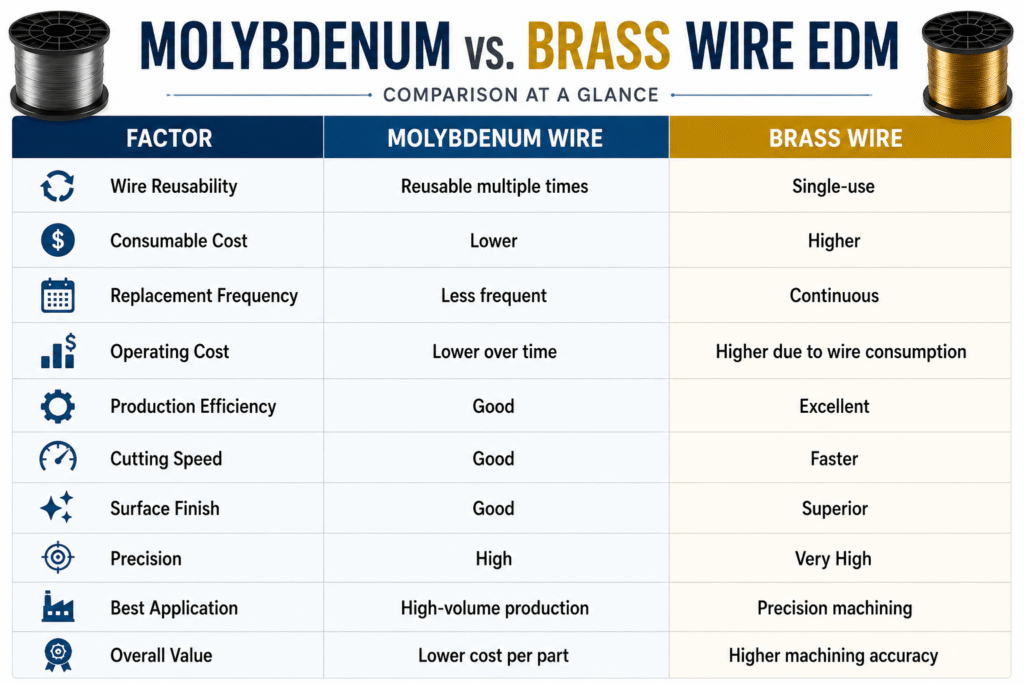
For shops focused on reducing operating expenses, molybdenum wire often offers a lower total cost of ownership due to its reusable nature.
Performance Comparison
While cost is important, machining performance should also be considered.
Cutting Speed
Brass wire generally provides faster cutting speeds due to its electrical conductivity and optimized spark generation.
Surface Finish
Brass wire often produces smoother finishes, making it ideal for precision molds, dies, and complex components.
Accuracy
Both wire types can deliver accurate results, but brass wire systems are often preferred when ultra-tight tolerances are required.
Durability
Molybdenum wire offers excellent durability and wear resistance, allowing it to withstand repeated use without frequent replacement.
When Molybdenum Wire is the Better Choice
Molybdenum wire may be the right option if your shop:
- Prioritizes reducing consumable costs.
- Handles high-volume production runs.
- Requires reliable performance for general precision machining.
- Wants to maximize operational efficiency while controlling expenses.
Industries such as tool and die manufacturing, general engineering, and component production often benefit from molybdenum wire systems.
When Brass Wire is the Better Choice
Brass wire may be preferable if your operations require:
- Exceptional surface finishes.
- High-precision machining.
- Faster cutting speeds.
- Complex geometries and intricate details.
Industries such as aerospace, medical device manufacturing, electronics, and precision mold making frequently rely on brass wire EDM for critical applications.
Conclusion: Which is More Cost-Effective for Your Shop?
The definition of “cost-effective” depends entirely on your shop’s specific output.
Choose Molybdenum Wire if:
- You primarily handle high-volume, batch production of standard parts.
- Your tolerance requirements are moderate (e.g., within $\pm 0.01\text{ mm}$).
- You want to minimize your ongoing consumable expenses and are comfortable with a slightly rougher surface finish.
- You run continuous, un-monitored jobs where wire breakage must be avoided at all costs.
Choose Brass Wire if:
- You are a high-precision tool and die shop making molds, punches, or medical components.
- You require pristine surface finishes straight off the machine.
- Your workflow involves highly complex geometries, variable tapers, and tight corners that demand fresh, perfectly round wire for every millimeter of the cut.
Final Thoughts
Both molybdenum and brass wire play important roles in modern EDM machining. While brass wire remains the preferred choice for premium precision applications, molybdenum wire offers a compelling advantage for manufacturers looking to reduce operating costs without compromising performance.
Before making a decision, evaluate your production volume, accuracy requirements, and long-term consumable expenses. A careful assessment will help ensure that your EDM process delivers both productivity and profitability.