
Wire EDM is often selected when conventional machining reaches its limits — especially for intricate contours, tight tolerances, and hard materials. However, simply choosing Wire EDM does not automatically guarantee the best outcome.
The efficiency, cost, and accuracy of the final component depend heavily on how the part is designed and planned before machining begins. Understanding a few key considerations early in the process helps avoid delays, unexpected costs, and redesign cycles later in production.
This article highlights the most important factors engineers and product teams should review before moving forward with Wire EDM machining.
Start with the Function of the Component, Not the Process
A common mistake in early-stage manufacturing planning is selecting Wire EDM simply because it delivers high precision.
Instead, the first step should always be evaluating what the component actually requires:
- Does the part include intricate internal contours?
- Are sharp corners necessary?
- Is the material difficult to machine conventionally?
- Are tolerances extremely tight?
Wire EDM is ideal when the geometry demands accuracy beyond what rotating cutting tools can reliably achieve. But when simpler machining methods can produce the same result efficiently, they may be the better option.
Choosing the right process begins with understanding the part’s functional needs.
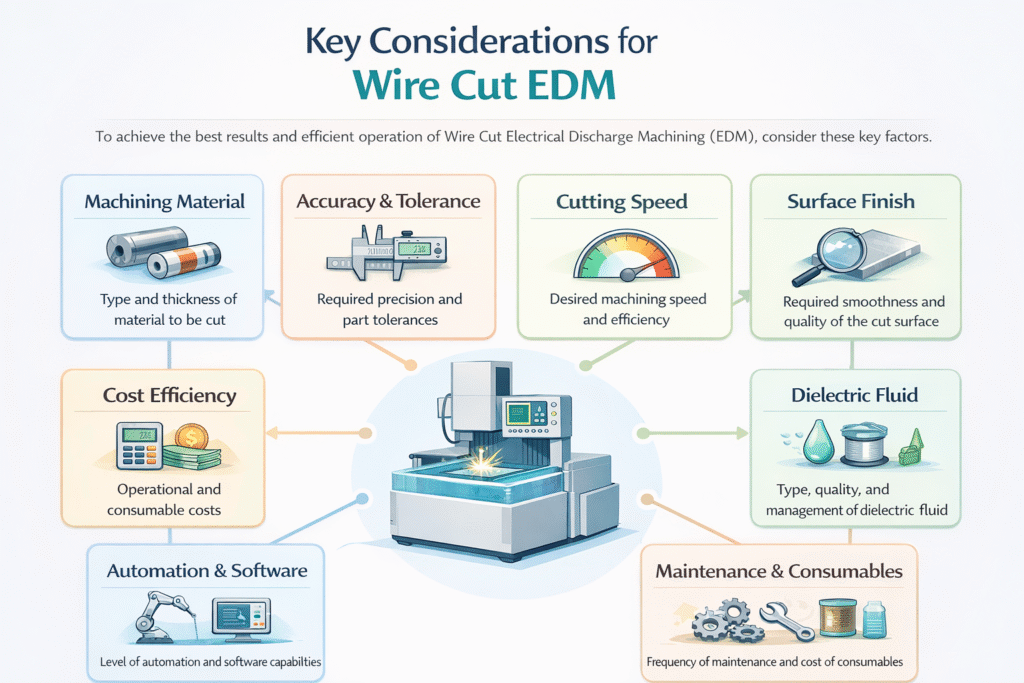
Wire EDM is excellent at producing complex shapes, but geometry still affects how efficiently the process performs.
For example:
Thin ribs, variable thickness sections, and unsupported profiles may increase machining complexity. In some cases, they can influence surface consistency or cutting stability during long operations.
Designers who evaluate geometry early can often make small adjustments that significantly improve manufacturability without changing component performance.
This step alone can reduce machining time and improve repeatability across production batches.
Wire Selection Influences More Than Just Cutting Speed
Many assume EDM wire selection is a machine-level decision. In reality, wire choice directly affects surface quality, accuracy, and production efficiency.
Although multiple wire types are available, 0.010-inch brass wire is widely used across industries because it balances conductivity, strength, and reliability during cutting.
Special coated wires may be recommended when:
- surface finish requirements are demanding
- thicker sections are involved
- higher productivity is required
- material characteristics increase wire wear
Matching wire type to part requirements improves both stability and output quality.
Tolerances Should Match the Application — Not the Capability of the Machine
Wire EDM machines are capable of extremely tight tolerances. However, specifying maximum precision without functional necessity can increase machining time considerably.
Each additional finishing pass improves surface integrity but also extends production cycles.
Instead of requesting the highest achievable finish by default, it is more effective to define tolerances based on how the component will actually perform inside the assembly.
This keeps the machining strategy efficient while maintaining required quality levels.
Material Choice Directly Affects Machining Strategy
Wire EDM only works with electrically conductive materials, but performance varies significantly between them.
Tool steels, stainless steels, titanium alloys, carbide, and tungsten are all commonly processed using Wire EDM. However, material thickness and conductivity influence cutting speed and surface consistency.
Selecting the material early in the design phase allows machining parameters to be optimized before production begins.
In many cases, this helps reduce overall lead time while maintaining dimensional accuracy.
Surface Finish Expectations Influence Production Time More Than Expected
One of the strengths of Wire EDM is its ability to produce very fine surface finishes.
However, achieving ultra-smooth surfaces typically requires multiple trim cuts after the initial pass. While this improves surface quality, it also increases machining duration.
Understanding whether the component truly requires a fine finish — or simply dimensional accuracy — helps define a more efficient machining plan.
Balancing finish requirements with functional needs often leads to better production timelines.
Programming Quality Determines Process Stability
Even with advanced machines, Wire EDM results depend heavily on programming accuracy.
Modern CAD/CAM systems allow engineers to simulate wire paths before cutting begins. These simulations help detect potential issues such as unstable contours or collision risks.
Verifying the program before machining reduces the chance of wire breakage and improves consistency, especially for high-precision components.
Close coordination between design and machining teams strengthens this process further.
Lead Time Planning Is Just as Important as Technical Planning
Compared to milling or turning, Wire EDM typically requires longer machining cycles. This is especially true when parts involve:
- thick sections
- intricate contours
- tight tolerances
- high surface finish expectations
Considering these factors early allows production schedules to remain predictable and prevents bottlenecks later in the workflow.
Early collaboration with machining specialists often helps identify opportunities to improve throughput.
Working with the Right Machining Partner Makes a Measurable Difference
Even a well-designed component can face challenges if the machining strategy is not aligned with production capability.
Experienced Wire EDM providers support projects by:
- reviewing manufacturability early
- suggesting geometry improvements
- recommending suitable wire types
- optimizing cutting strategies
- maintaining inspection consistency
This collaborative approach reduces iteration cycles and improves overall manufacturing efficiency.
Final Thoughts
Wire EDM is one of the most reliable solutions for producing complex precision components, particularly when conventional machining methods fall short.
However, the best results are achieved when geometry, material selection, tolerance requirements, programming strategy, and timelines are considered together rather than individually.
Taking a design-aware approach to Wire EDM planning helps manufacturers improve accuracy, reduce production delays, and maintain cost efficiency across both prototype and production environments.